.png)


If your student attends an elite private school in or around Manhattan, you know the answer to this question isn’t as simple as it implies.
You’re paying north of $60,000 a year in tuition. Your student’s school has dedicated college counselors — professionals with deep experience, direct relationships with admissions offices across the country and an institutional track record that most high schools could never replicate. Schools like Dalton, Trinity, Collegiate and Horace Mann matriculate roughly 25% to 35% of their graduating classes to Ivy League and top universities. These are numbers that reflect genuine infrastructure, not luck.
Do you need anyone else in your corner? The honest answer is that it depends on what you think the job actually is.
The value of a school’s college counselor
At Dalton, over 100 college admissions representatives visit campus each fall to meet with students during the school day. Horace Mann’s counseling team brings more than 100 combined years of admissions experience, with counselors who have worked inside admissions offices at Brown, Duke and Harvard. Collegiate works with two dedicated college counselors who guide each student through the exploration and application process.
This is substantial support. The institutional knowledge these counselors carry — which colleges are looking for what, how a particular school’s transcript reads in a particular admissions office, what has worked for students with similar profiles in years past — is valuable and hard to replicate elsewhere.
Limitations of college guidance counselors at your school
The limits are specific. At Trinity, there is no formal interaction with the college counseling process in 9th grade. The first introduction is Junior College Night in December of junior year. At Horace Mann, students are assigned a college counselor in the second semester of junior year, with two to four individual meetings before senior year and four to eight once applications begin. At Dalton, individual meetings also start in the second semester of junior year — group presentations only before that. Ninth and 10th-grade guidance at Collegiate is limited to general advice: do well in class, stay involved and be active in the summer. No individual college counseling meetings happen at all until junior year.
For a process that shapes critical years of a young person’s life, the individual guidance doesn’t start until 17 months before most applications are even due.
There’s a structural issue at play, too. Your school’s college counselor isn’t only working for your student. They’re working for the institution. That means maintaining relationships with admissions offices, protecting the school’s placement record and managing a senior class full of students with overlapping goals. When two kids from the same school want to apply early decision to the same university, someone’s interest wins out. When advocating hard for one student risks a long-standing relationship with an admissions office, that calculation exists whether anyone names it or not.
It can also look like something more concrete. We’ve worked directly with students from schools that cap how many reach schools, match schools and safety schools a student can apply to — three of each, nine total. A reach school is one where even well-qualified students don’t get in most of the time. A match is one where your student is a competitive candidate. A safety is one where admission is likely. Nine schools across those three categories sounds reasonable on paper. In practice, it’s a ceiling set by the school’s interests, not your student’s.
Inside Higher Ed has reported on elite private schools that have had application caps for decades. When one such school was asked about its policy, it agreed to speak only on the condition it not be named, because, as the reporting made clear, the motivation wasn’t all about the student. The school’s own college guidance counselor acknowledged this head-on: if 50 seniors apply to the same school and only 20 get in, a cap helps manage that distribution.
What it doesn’t do is maximize the individual student’s shot and angle.
And here is something every family navigating a school with this kind of policy should understand: no high school has the legal authority to prevent a student from applying to as many colleges as they choose. The Common Application allows up to 20 schools. Students can go beyond that through individual portals. A school’s cap is a policy, not a hard stop, and knowing the difference matters.
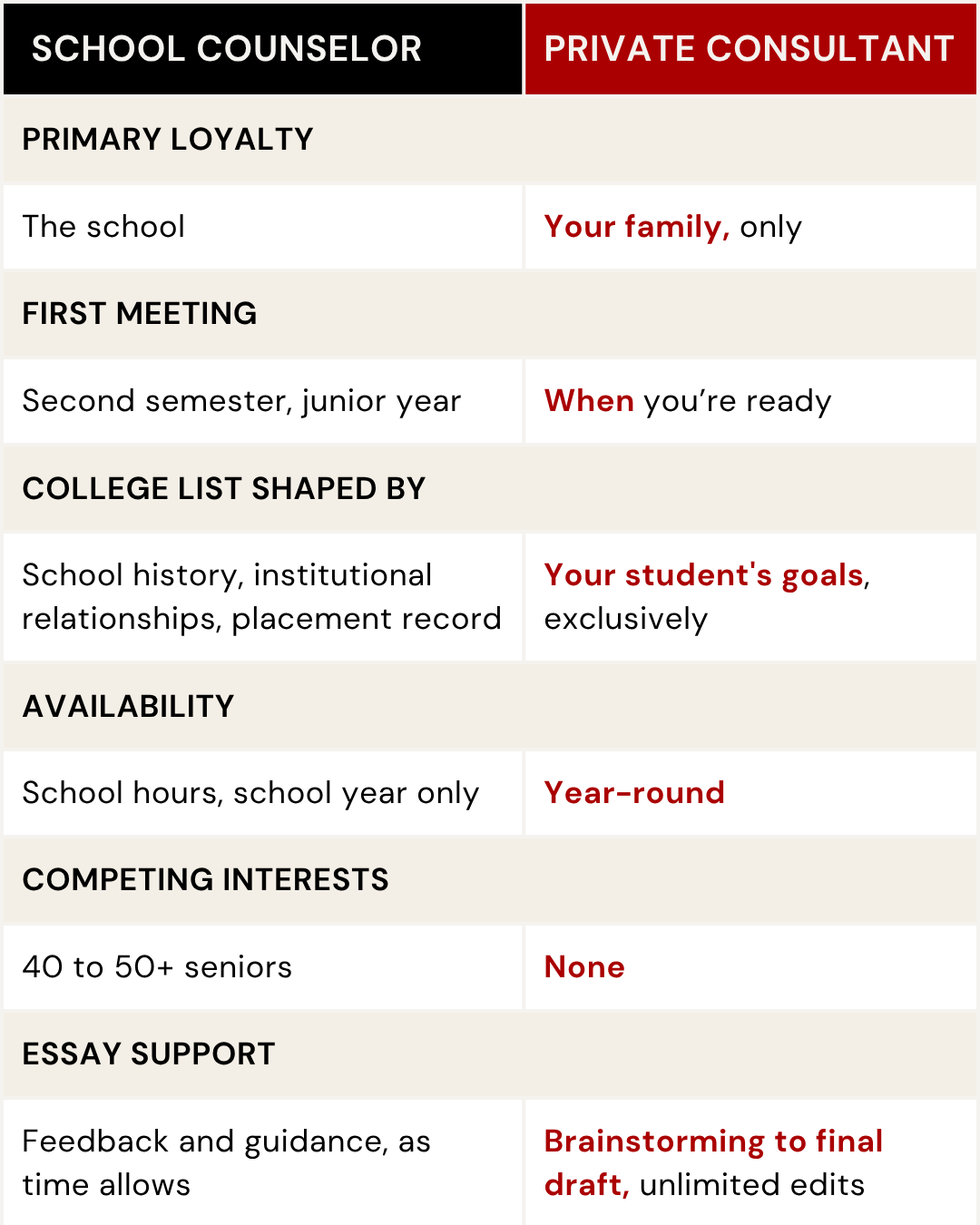
How does a private college consultant change things?
The consultant works for the family, parent and student together, with the student’s outcome as the north star.
There are no institutional relationships to protect, no placement statistics to manage, no competing students in the room. The college list gets built around your student’s actual profile and goals, not around what has historically worked for the school’s brand on paper. The application strategy is calibrated to one person.
The relationship starts well before senior year. At Admissions Angle, the process begins with a deep-dive student interview — not a form, but a real conversation designed to surface the qualities, experiences and ambitions that will eventually drive every piece of the application. From there, a personalized roadmap gets built specifically for your student. That kind of sustained, singular attention is simply outside the scope of what any school counselor, however talented, can offer.
Do you need a private college advisor?
If your student is one of many competing for attention in a counseling office with finite hours, if the college list conversation feels generic, if you’ve ever wondered whether the advice you’re getting is optimized for your student or for the school — those are the questions worth sitting with.
Your school counselor is an asset. A private consultant is a different kind of asset. The families who understand the distinction tend to use both well.


.jpg)


