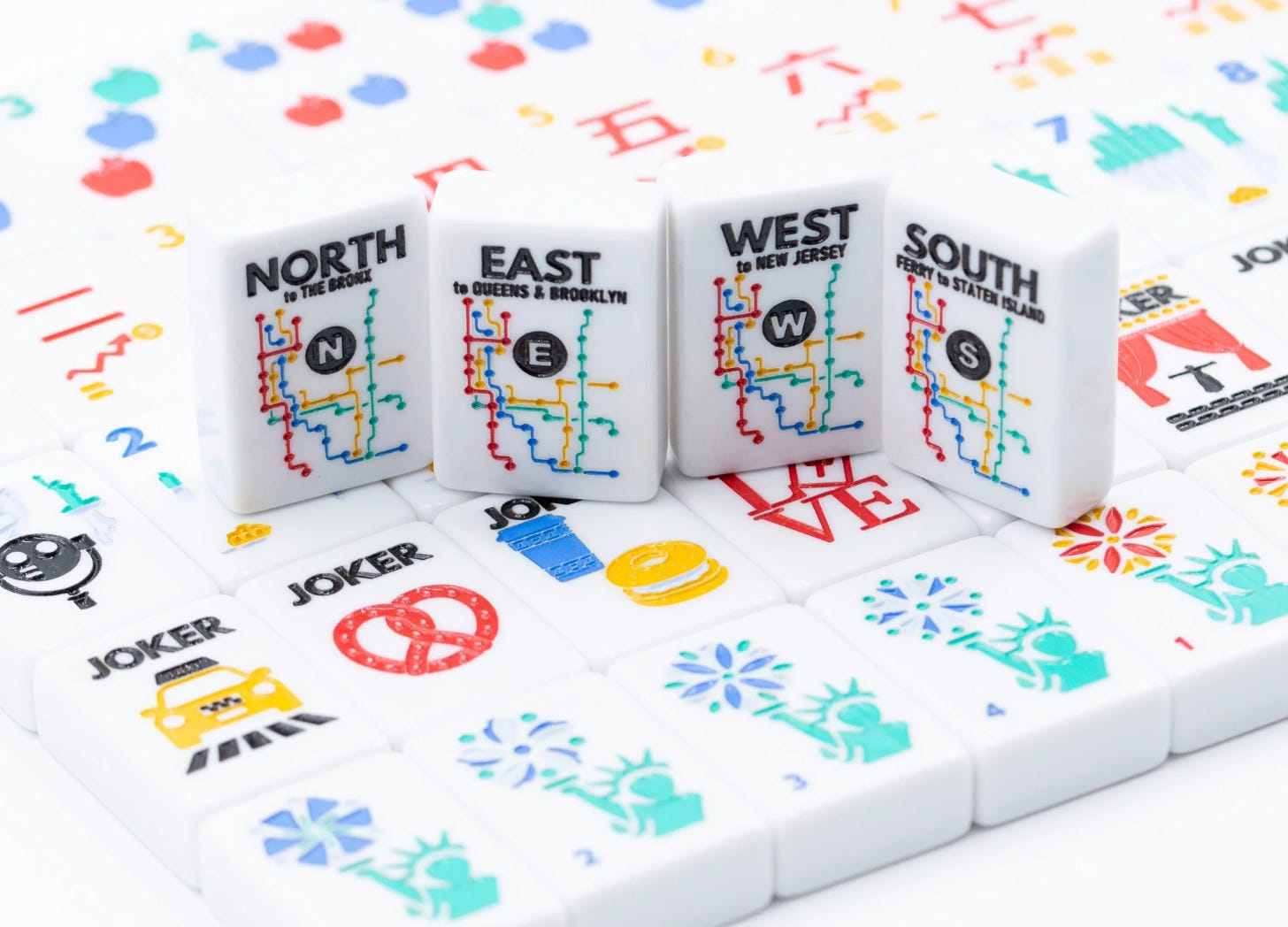
Mahjong has 144 tiles, no battery and zero notifications. It requires four players, a table and enough focus to track every discard your opponents make while protecting your own hand. The name itself, 麻雀, mā què, means sparrow in Chinese, a nod to the sound the tiles make when they click together. In America, mahjong has been mostly associated with a specific kind of afternoon: Jewish ladies in New York or Florida, a card from the National Mah Jongg League and a table full of people who knew each other well enough to play in intentional silence.
Now Gen Z is obsessed with it.
Yelp named mahjong a top trend of 2026, reporting that searches for mahjong clubs surged 4,467% year over year between fall 2024 and fall 2025, with searches for mahjong lessons up 819%. Eventbrite recorded a 179% increase in U.S.-based mahjong events from 2023 to 2024 alone. At George Washington University, students are spending weekends around the tile table, drawn to the game’s mix of competition, ritual and charm. San Francisco’s Youth Luck Leisure Mahjong Club draws up to 200 players per session, often with a waitlist. New York’s Green Tile Social Club has become a destination for younger players connecting with their cultural heritage, the New York Times reported.
@Antoine | 杰安 over at Mandarin Zest Magazine reported last week that mahjong-related content on TikTok has reached enormous scale, with search interest rising continuously — and that what was once associated with older Chinese communities has moved firmly into mainstream American social life, driven almost entirely by young people discovering it through clubs, classes and in-person events.
Writing in Business Insider this week, Gen Zer Amanda Geffner described how mahjong pulled her away from screens and into something she didn’t expect: a standing social ritual with her mom, cousin and family friends.
“Mahjong rewards patience instead of instant gratification,” she wrote. “It encourages real-life conversation over scrolling.”
The cultural history behind that pull runs deeper than the trend cycle suggests.
@Michelle Blaser explored the deep cultural roots of the game over at The Pollinatr — including how Jewish women in New York took up the game in the 1920s, eventually founding the National Mah Jongg League in 1937 to standardize rules and formalize what had become a genuine community institution. That history is not incidental to the current moment. For many young Asian-American and Jewish-American players, mahjong isn’t necessarily a trendy new hobby, but a thread back to something that was always theirs.
Japan is where the trend among young people is furthest along. A Japan Productivity Center report found that 17.6% of male teens and 9% of female teens played mahjong at least once in 2023, the highest rate of any age bracket. Since then, teen participation roughly doubling in just two to three years.
The wave has spread to South Korea, where the education race begins before children can talk, and our work in Seoul has allowed us to see this first-hand. Parents seek to secure spots at elite preschools long before their kids can even go, and teens hop from high school classes to after-school “cram centers” called hagwons. The Suneung, South Korea’s national college entrance exam, isn’t just an academic assessment, it’s akin to a societal ritual. One so consuming that the entire country rallies around it, with companies staggering work schedules, construction coming to a stop and airports grounding flights during a particular section. These are the students gravitating toward mahjong. The fact tthat the most academically pressured teenagers in the world are choosing a strategy game instead of checking out entirely says something.
Much of the mahjong digital gateway runs through Mahjong Soul, a free-to-play online platform that faithfully recreates the rules and mechanics of riichi mahjong while wrapping them in anime-style characters. Herin lies the entry point for a generation that grew up gaming. The physical tiles came later and the critical thinking skills came with both.
The actual mahjong sets themselves have become objects of desire and the mahjong market is split in two. On the higher end, Oh My Mahjong has turned the tile table into a lifestyle “event”, with sets running from $400 to over $600, sold at Revolve. And then there’s Prada’s set, which costs $7,800!
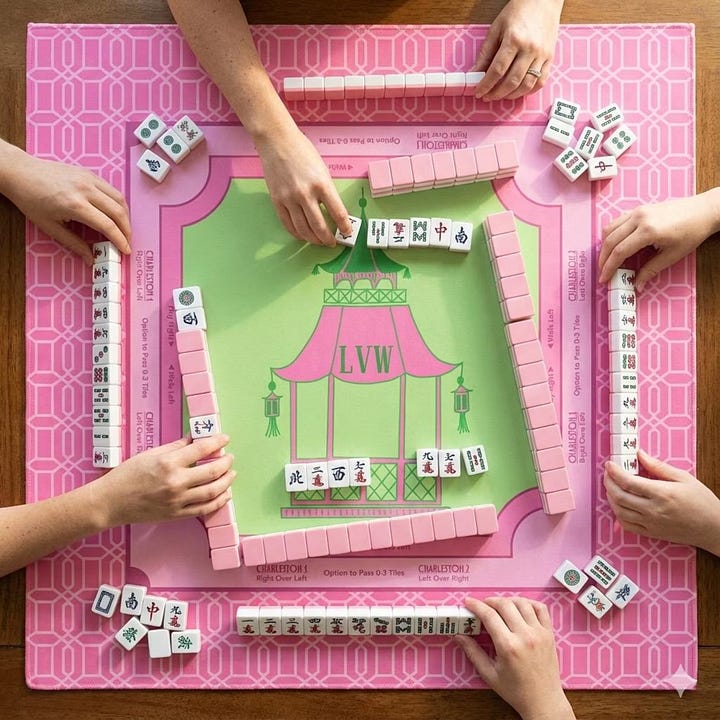
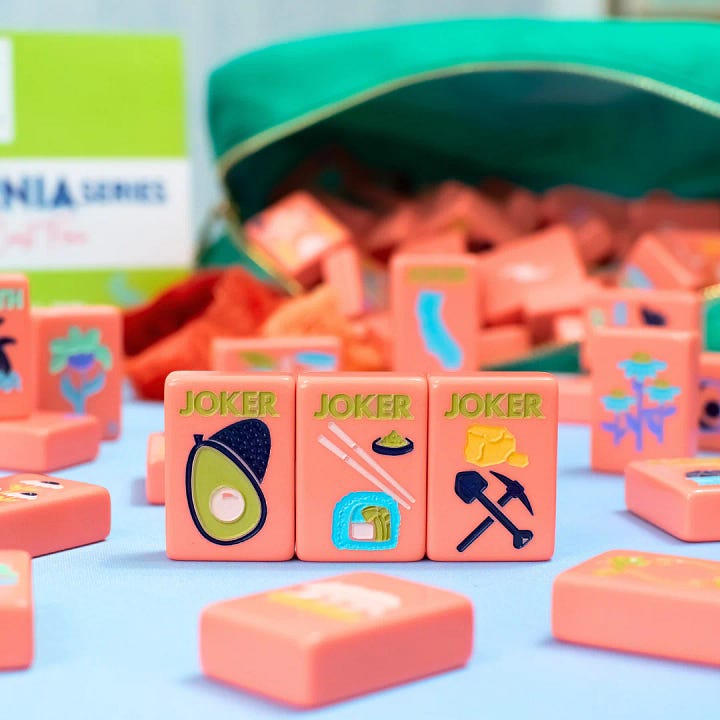
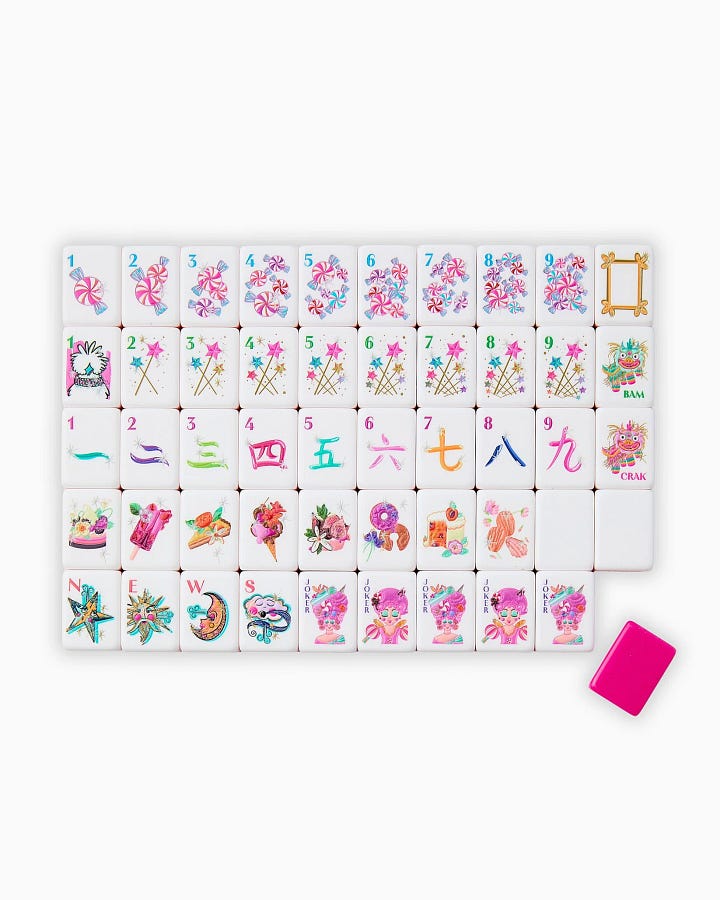
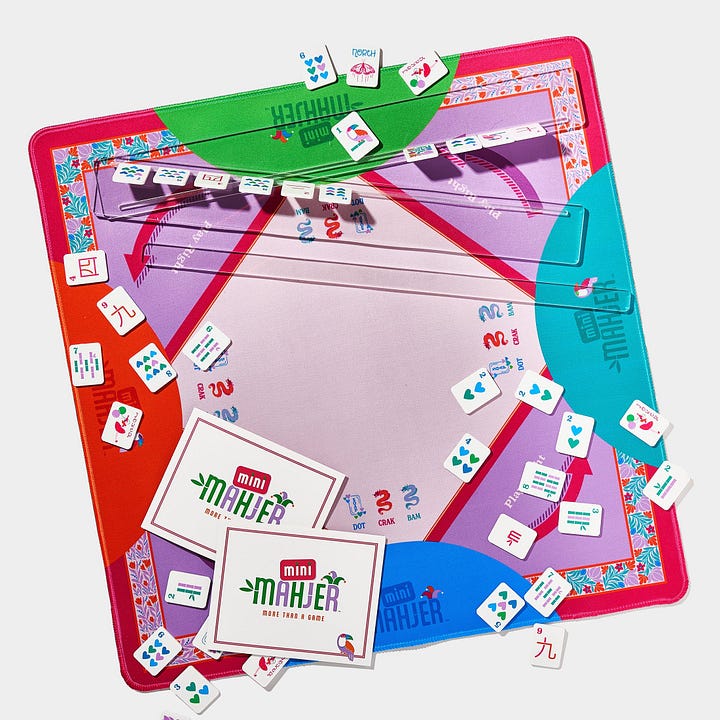
On the accessible, design-forward end, brands like My Fair Mahjong, whose destination-themed, brightly colored sets are sold at Dillard's, and The Mahjong Line, known for its bold artwork and color-coded tiles, are making the game feel young, personal and worth owning.
The set on your table has become a signal. Like a tennis racket in the 80s or a Peloton in 2020, the mahjong set someone owns says something about who they are — tapped in and culturally fluent. That calculus has pushed the market in two directions simultaneously: toward the aspirational and toward the expressive.
Town & Country noted tiles are "clacking in the well-decorated homes of the urban elite." When Prada is selling you a mahjong set and Dillard's is stocking the colorful version for everyone else, the trend has officially crossed over.”
144 Tiles. No Easy Moves.
The trend is interesting, but what's happening cognitively at the mahjong table is more interesting.
Mahjong is a rigorous mental workout that happens to look like a good time. Players must hold an enormous amount of information simultaneously: which tiles have been discarded, which hands are still theoretically possible, what an opponent’s recent discards suggest about the hand they’re building and whether their own strategy should hold or pivot entirely. The game rewards players who can think several moves ahead while staying responsive to a board that changes with every draw. For context on just how cognitively demanding the game is: researchers presented at the IJCAI 2025 Mahjong AI Competition found that the average size of information sets in mahjong is around 10⁴⁸ — dwarfing the complexity of poker, bridge and even chess. Building an AI that can play it well remains one of the harder problems in game theory. A teenager learning to navigate it at a table with three opponents is doing something demanding.
The skills it develops:
Strategic planning. Players must decide whether to commit to a target hand or remain flexible as the game shifts. The best players hold their strategy loosely — ready to abandon a strong hand if the board turns against them. That capacity to pursue a goal while staying open to changing course is not a mahjong skill. It is a life skill.
Risk management. Every discard is a calculated bet. Releasing a tile that moves your hand forward might simultaneously hand an opponent exactly what they need to win. Learning to weigh that trade-off — quickly, under pressure, with incomplete information — translates directly to standardized testing strategy, group project dynamics and eventually to every high-stakes decision a young person will face.
Working memory. Tracking which tiles have already been played is essential to knowing what’s still possible. Players who can hold that information and update it in real time develop faster, more accurate thinking habits over time. This is not incidental — it is the cognitive core of the game.
Pattern recognition. Scanning the board, identifying sequences, spotting an opportunity before an opponent does. This is analytical thinking dressed up as entertainment — and it gets sharper with every game played.
Patience and sustained focus. Mahjong cannot be rushed and cannot be played while distracted. The game structurally requires full presence over an extended period — a capacity that’s become rare among teenagers and valuable everywhere else.
None of these are mahjong-specific. They are transferable, durable and exactly the competencies that show up in strong academic performance, compelling college essays and, eventually, professional success.
Logging Off to Level Up
There is a quieter dimension to this trend that is easy to miss. @Madeleine Michelle spoke with Nicole Stock, a Dallas-based licensed psychologist, about what is actually driving Gen Z toward screen-free hobbies in her piece earlier this year.
“When we’re constantly overstimulating our brains to need that high level of dopamine,” Stock said, “everything else is going to seem that much more boring.”
The rise of analog hobbies among young people, Stock argues, correlates directly with a desire to limit the kind of scrolling that trains the brain to crave a stimulation it can rarely find in real life.
Mahjong structurally solves that problem. NPR’s reporting on the surge notes that younger players are drawn to the game as a source of in-person connection and intentional time off their phones — one player noted she spent four hours at the table and checked her phone only to change the music. No notifications. No scroll. Just tiles.
For high schoolers navigating an environment that is increasingly aware of what constant connectivity costs — in focus, in social fluency, in the ability to sit with discomfort — choosing an activity that demands full attention is its own form of self-knowledge. And self-knowledge is exactly what the college essay is designed to surface.
A student who can write about learning to read an opponent’s intentions through a sequence of tile discards — and connect that honestly to how they approach a difficult conversation, a group project or an unexpected setback — has found the through-line that makes a great essay great. The game is the vehicle. The insight is what matters.
AI Is Playing, Too
Here is where it gets even more interesting for students already thinking about technology’s role in their education. Players across gaming communities have begun using AI tools to accelerate their learning — running bots to practice tile strategy, simulate opponent behavior and identify weaknesses in their decision-making before they sit down at a real table. Mahjong Playbook’s 2026 breakdown of AI in the game notes that AI opponents provide consistent practice and immediate feedback in ways human opponents cannot — helping new players build pattern recognition and risk assessment skills faster than traditional learning allows.
The irony is sharp and worth naming: Gen Z is using the most advanced technology available to get better at a game specifically because it takes them away from screens. That is not a contradiction. That is exactly the kind of lateral, adaptive thinking that admissions essays are built around.
The Difference Between a List and an Angle
The activities section of a college application is one of the most misread parts of the process. Families often approach it as a checklist: volume, variety, title. Admissions officers read it differently. They are looking for evidence of genuine engagement: a student who chose something, stuck with it and went deep enough to have something real to say about it.
A student who has been playing mahjong seriously for two years, who can speak to the strategy, who started a club, who taught a younger sibling, who placed in a regional tournament, has a story. It is specific. It is unusual. It is entirely theirs. That specificity is what makes an application memorable, and it is exactly what the activities section is designed to surface.
The same logic applies to any analog hobby a student picks up with genuine interest. What matters is depth, ownership and the ability to articulate what the experience taught them about how they think. Mahjong, taken seriously, gives a student all three.
The students who stand out in applications are rarely the ones who did the most things. They are the ones who did a few things with enough commitment to have something real to say about them.
Final Discard
Mahjong has been around for 2,000 years. It survived the transition from bone tiles to plastic, from Shanghai parlors to New York living rooms, from your grandmother’s Sunday afternoon to a Friday night in a college dorm. It is still here because the thing it offers — the particular satisfaction of outthinking three other people in a room, without a single notification — turns out to be something no app has been able to replicate.
Gen Z figured that out. The question for families with high schoolers isn’t whether the trend is real. It is whether your student is building the kind of depth, focus and engagement that makes any activity — mahjong or otherwise — worth putting on a page that matters.
The tiles have been on the table the whole time.



.jpg)